The Parade Could Hardly Be Called Distinguished
Five years before founding the company Bernhard Völker, our ancestor kept a diary. Reverence was not exactly his strong suit.
In old family photographs everyone looks serious. Bernhard Georg Völker is no exception: dark suit, beard, a nineteenth-century man you'd readily assume spent his life in that dignified severity old photographs lend anyone who stands still long enough.
Fortunately, he also wrote.
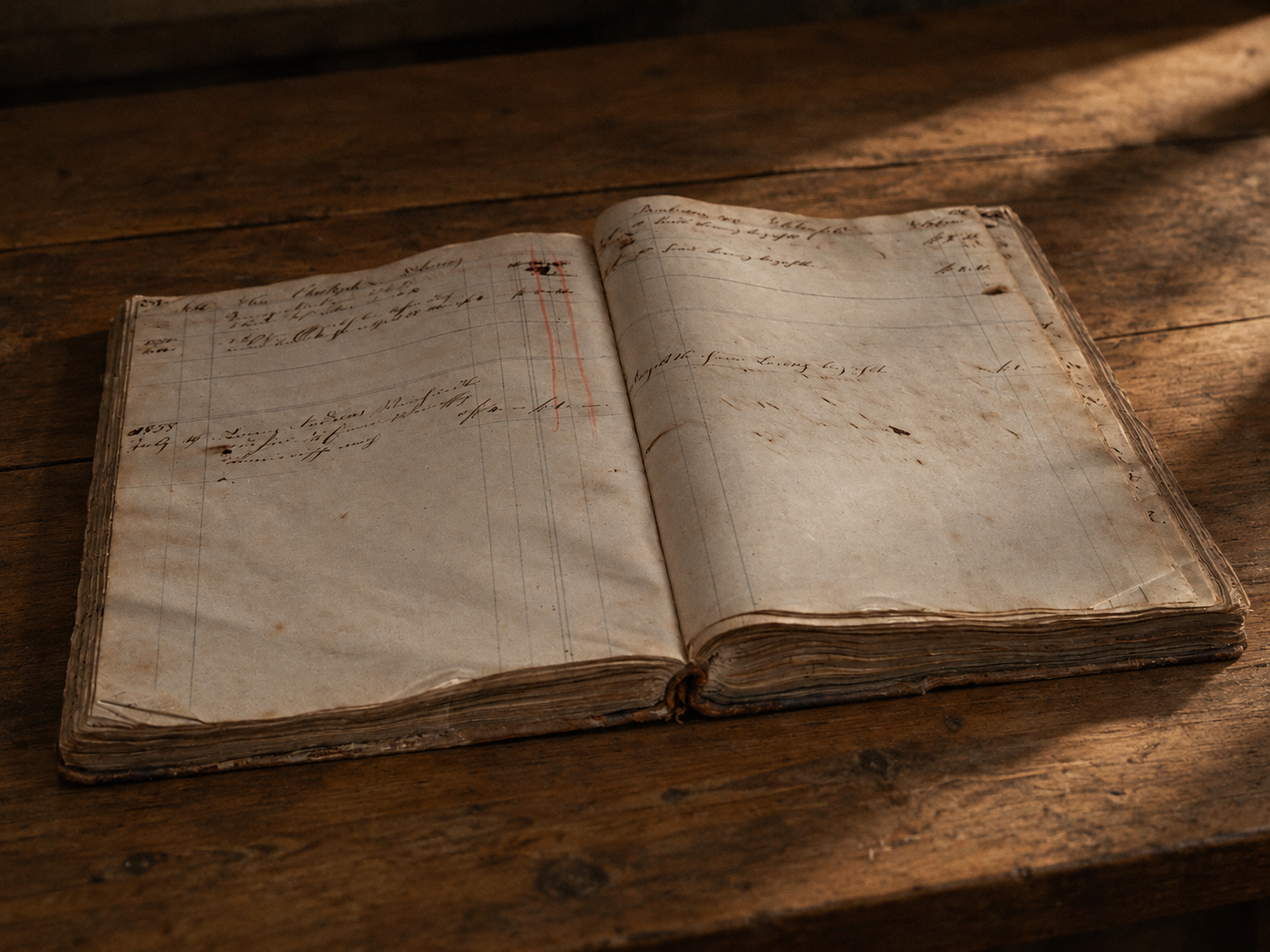
Between 1837 and 1839 Bernhard Georg kept a diary he called his "Andeutebuch", roughly a book of hints and passing remarks. A few years later he founded the company that still bears his name. What you meet in its pages, though, is less the venerable founder than a young citizen of Kitzingen with a remarkably dry eye for the world around him.
On 22 July 1838 an important visitor was expected. King Ludwig I of Bavaria was due to pass through Kitzingen, and the town prepared a reception fit for the occasion. Citizens were summoned for a parade, a major was to greet the king, and the neighbouring villages had put up triumphal arches. It didn't go particularly well.
Bernhard Georg summed it up briefly:
"The parade could hardly be called distinguished."
The king arrived on time, but apparently not where anyone expected him. The major hadn't turned up yet; his adjutant had left his horse at an inn and no time to fetch it. The mayor was missing too, and the flag arrived late. In Dettelbach and Mainstockheim, farmers had waited for hours beside their triumphal arches, in vain, because Ludwig took a different route. Bernhard Georg's comment was hardly more reverent: "One suspects he did it on purpose."
We like that. It doesn't reveal some deep trait in the future company founder; perhaps he was just having a good day. But sentences like that are why we read old documents. A date like 1843 makes history tidy. A registration sets a beginning, a ledger provides figures. A sentence about a botched parade brings a person back.
Before 1843
Bernhard Georg was a master cooper. In 1843 he registered a company under his own name, its business listed as "viticulture, wine trade, vinegar making". The oldest surviving ledger dates from 1847.
He founded it at a time when Germany's economy was changing fast. The Customs Union had begun turning a patchwork of states into a single market. Trade and shipping on the Main were growing. Kitzingen already had a sizeable number of wine merchants, and a few decades later the railway brought the next boost: from 1865, wine could travel to Munich, Frankfurt or Berlin far more easily.
So when a cooper turned a family business grown over generations into a registered company, it wasn't a family matter in a vacuum. It belonged to a larger movement. That is exactly what interests us about the past today: look back far enough and you don't find a tradition handed down unchanged from one generation to the next. You find people responding to changing circumstances.
One of our ancestors came to Kitzingen from the Spessart around 1695 as a cobbler and became a winegrower. Later generations combined winegrowing with cooperage and trade. Bernhard Georg founded a company. Later, Carl Völker took advantage of the railway and growing trade and moved the business to Güterhallstraße.
Today we make natural wine. That's not a straight line.
A second encounter with the king
A few months after the ill-fated parade, Bernhard Georg saw Ludwig I again, this time leaving by steamship. His verdict hadn't grown any more polite. The king was an "unusual king", he noted, because he did many things "regardless of right or wrong" and was mainly concerned with promoting art and science.
It would be a stretch to turn this into a tale of republican resistance; the diary doesn't give us enough. But we can say that Bernhard Georg watched and wrote down what he saw, rather than what one was presumably supposed to write about a king.
Five years later this man founded the company Bernhard Völker. Nearly two centuries on, his books are still here in the house. Our wine has probably doesn't have much in common with his. His view of parades, rather more.