How was the 2026 vintage?
We hear this question every autumn. Usually, an answer comes easily. This year it takes a few numbers and some patience.
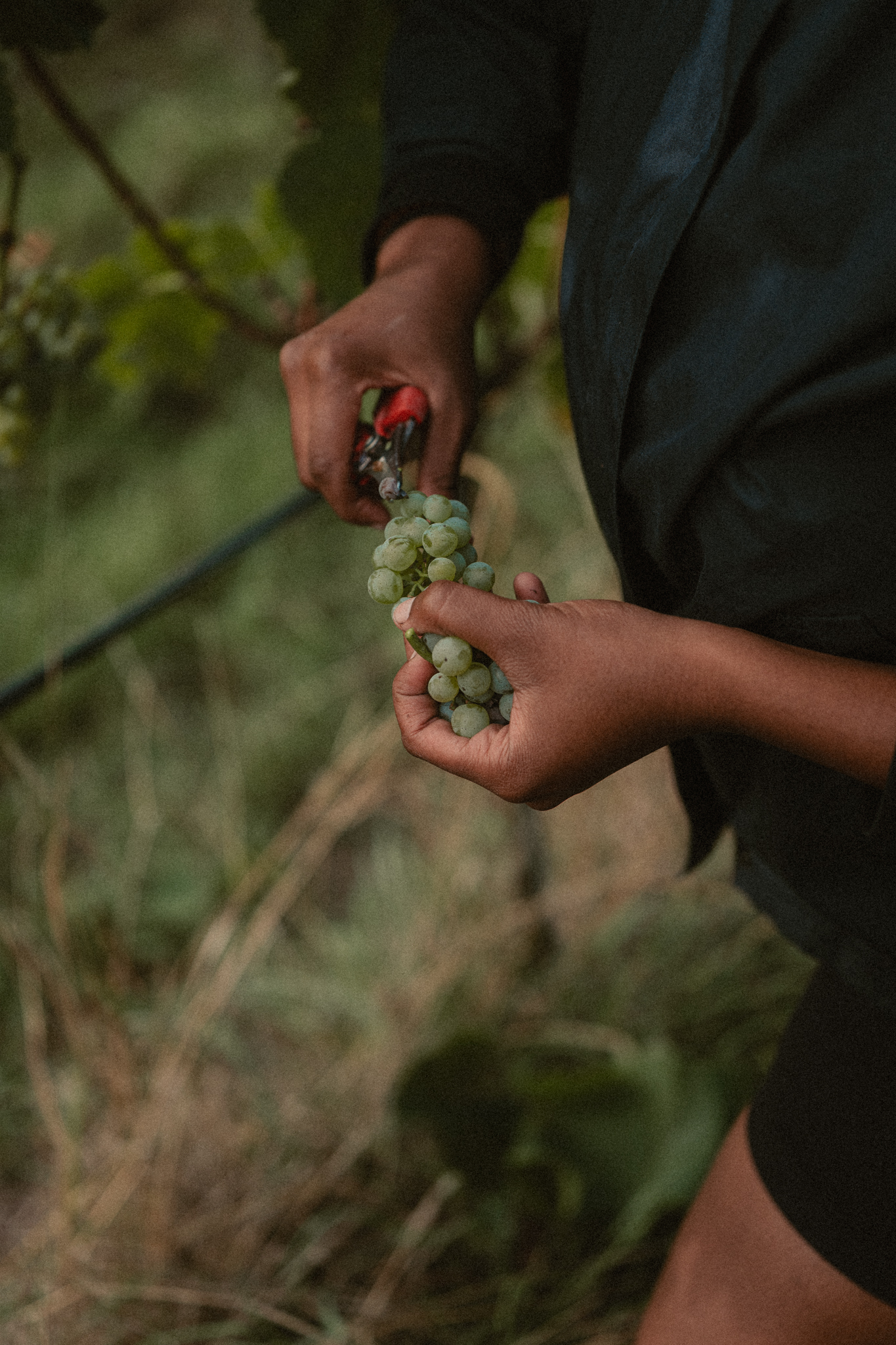
There are customers who ask this in passing, somewhere between paying and saying goodbye, expecting one word in return. Hot. Wet. Mixed. 2026 won’t give us that. It was the driest year since we started keeping records, and an early one: by late August the first ripe grapes were hanging, by mid-September the harvest was over. Ten years ago we’d barely have started by mid-September.
If you want one word from us now, it’s: concentrated. But concentrated isn’t a flavor, it’s a claim, and claims should be backed up.
Small Berries, High Numbers
Drought means, first of all, less water in the berry. The berries stayed small, some shriveled outright, and we sorted those out before they pushed the must weight even higher than it already stood. Our lots this year ranged between 19 and 25 degrees Brix, several parcels well above 21. Must weight only tells you how much sugar is dissolved in the juice. How much alcohol comes of that is decided later, in the cellar, and this year that’s proving harder than usual.
Smaller berries also mean more skin relative to juice. In wines fermented on the skins, that shows up directly as color and tannin. In the whites we press straight off, the effect is quieter, because the juice spends so little time with the skin. Concentrated and phenolic, then, mostly where we ferment on the skins, and otherwise more in the sugar than in the tannin.
What doesn’t line up so neatly: the acidity. Anyone who equates heat with low acidity gets a clear answer from our Eselsberg Riesling. 9.2 grams per liter, higher than in most years. The site sits high enough that the nights stayed cool while the days below in the valley were blazing. A vintage that keeps one rule and ignores the other.
Roots Without Water
In dry soil, nutrient uptake gets harder for the vine. That can show up later in the must, particularly in how well the yeast is supplied with nitrogen. Either way, our directly pressed musts are fermenting noticeably slowly this year. Wines fermented on the skins have an easier time of it, contact with skins and lees changes a few things in the must, though we can’t say for certain that this alone explains the difference.
Some of our wines will probably still be fermenting at Christmas. That’s not alarming, but for a while it’s the background noise in the cellar: a sluggish fermentation leaves more room for the wrong kind of bacteria, volatile acidity included. We’re keeping an eye on the barrels, more often than usual. Not out of panic. Out of experience.
Not Every Parcel
The temptation with a vintage like this is to tell a tidy story: dry, hot, low yields everywhere, done. That’s only half true. Our young planting at Apfelbaum, the Kleiner Fränkischer Burgunder, filled an entire barrel for the first time ever this year, high time, after such a long wait since planting. In a normal year it would have given considerably more; the barrel isn’t a record, it’s the first success at all. The Müller-Thurgau at Eherieder Berg also delivered well, but it too gave less than usual. Two parcels, two young-vine-and-yield stories, both under the same dry year.
We made one decision before the harvest, out of caution: no Pet-Nat. With sluggish fermentations foreseeable, we didn’t want to risk bottling a wine that would still be finishing its fermentation inside the bottle. Looking at the cellar now, that was the right call.
Every vessel is topped all the way to the bung. And among the slowly fermenting musts stand a few barrels we’re already looking forward to. Whether we’re right about that, we won’t know for at least a year.